FROM WASHINGTON:
Italy’s Five Star Movement (M5S), the protest party that swept to power across the country in 2014, has never been a particularly well-oiled machine. Today ends M5S’ online primary ahead of the 4 March national elections, and in the comments section one user wrote,
“It’s like a scifi horror (è roba da fanta-horror).”
“Worthy of a Black Mirror episode,” said another, on Twitter.
It was the common consensus. And while it doesn’t bode well for Beppe Grillo’s protest party – anti-establishment, vaguely Eurosceptic, occasionally environmentalist, dedicated to direct democracy and revolt against what they call the casta politica — it’s not particularly atypical, neither of the party nor of Italy, a country adrift.
M5S has always been at home online, where it began as a kind of discussion meet-up series organized by the comedian Beppe Grillo. Its core activists are young and tech-savvy. A digital primary, where people could vote from home for which prospective parliamentarians they wanted to see on the party list, made sense. But when the Corriere della Sera looked into the problems with Rousseau, M5S’ online voting program, they found a system that simply, agonizingly – prophetically — did not work. It was slow; it crashed repeatedly; it didn’t register clicks. And as the deadline drew near, with votes not registered, it became a nightmare. Roba da fanta-horror.
Many began to suspect foul play: that Rousseau’s crash wasn’t a case of incompetency at all, or at least not entirely. Many prospective candidates found themselves shut out, and rumors over social media have all pointed at a rigged system, a fake election. There’s been no definitive confirmation of these rumors as of this writing, but the irregularities abound. Activist Sonia Corrado had the rare pleasure of finding out, on Rousseau, that she was running for Senate. Several incumbents found themselves missing from the lists. And now a video has gone viral, purporting to be a secret recording of one M5S activist speaking to another.
“It’s a madhouse,” says one voice. “The system doesn’t work.” The voice, marked by a heavy Messina accent, is believed to be a M5S parliamentarian.
“I’m getting tired of all these problems created by the staff.”
There’s something strangely apropos about the M5S mess, especially as the March elections draw near. These elections will be the first under the new Rosatellum scheme, a continuation of the (mostly abortive) electoral reforms by which the ex-premier Matteo Renzi, of the center-left Democratic Party (PD), tried to fix the systemic problems of Silvio Berlusconi’s electoral reforms. These latter were called Porcellum – the swine reforms, in the sense of greed and shit.
Rosatellum, in the grand tradition of simple, high-functioning, easy to understand Italian politics, gives 36 percent of seats in both houses of Parliament to winners of a first-past-the-post election, and 64 percent to winners of a one-round proportional vote. (Other seats go to unelected Life Senators and parliamentarians elected by Italians abroad.) It’s a system that will reward coalitions; this had infuriated M5S, which has long taken pride in being a party that isn’t a party, a body of citizens organized along principles of direct democracy and in opposition to coalitions and compromises.
The Rousseau scandal may go a long way toward eroding that ideal.
PD, who have been hemorrhaging votes in the South since Renzi’s chinless posturing and pointless referendum in 2016, stand to lose too – if not to M5S than to a center-right coalition led by the odious Lega Nord and the ghost of Berlusconi, who is barred from holding office but currently appealing that ban in the European Human Rights Court in Strasbourg.
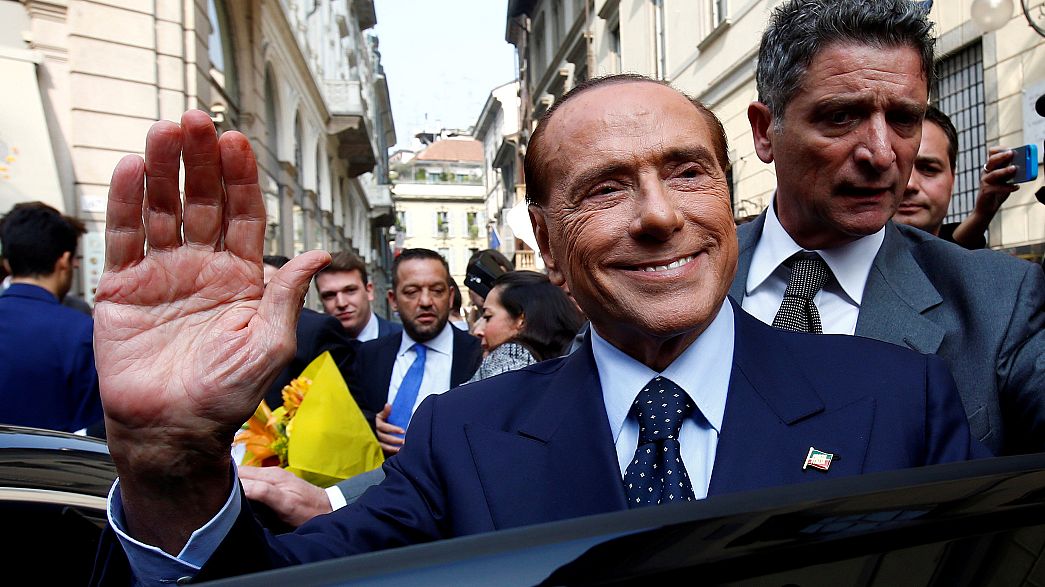
(He’s back!)
The election, in short, will be brain-achingly complicated. It’s not likely to do much, either: Italian public debt amounts to about 2.3 trillion Euro, second only to Greece in the Eurozone. Meanwhile Italy’s recession drags on and on; and as important a role as Italy plays on the European stage, from taking the lead on Mediterranean security to fielding high-ranking Eurocrats like Mogherini and Tajani, Italy has never looked more adrift, without direction and with precious little hope. It’s partly Renzi’s fault. It’s much more Berlusconi’s fault, incalculably more, for his erosion of civic discourse and his cultivation of public corruption unseen since the scandals of Bettino Craxi. And perhaps it’s simply in Italy’s stars to never quite function right, at least not yet or not now or not anymore.
M5S’ implosion is a sign of the times. Grillo’s party has a number of kindred spirits across Europe – notably in the Czech Republic, where the ANO (Yes!) Party has also stormed Parliament demanding an end to rule by the “elites.” ANO shares M5S’ technology fetish, its Euroscepticism and its friendly stance toward Russia. Anrej Babiš, ANO’s founder and now-ex-Prime Minister, shares Grillo’s charisma, salty language, and dictatorial instincts. His businesses are tied up inextricably with his party, like M5S with the Casaleggio Associates, a tech company founded by the late Gianroberto Casaleggio that has profited enormously from M5S’ rise to power.
Babiš just resigned after a no-confidence vote in the Czech Parliament – just ahead of a presidential election. In this season of bad faith, black omens and Black Mirrors, the ripples of fate may well be moving south.
 The Windrose