15 July, World Cup Final: Emmanuel Macron and Kolinda Grabar-Kitarović, President of Croatia, sharing a box and embracing each other. Vladimir Putin and Gianni Infantino, President of Fifa, in a separate box; Infantino signing footballs.
Marine Le Pen tweeting that she was très fière! of the victorious French side. Top scorers include Mbappé, four goals, born in what Trump would call a “no-go zone;” Pogba, one, Muslim of Guinean descent; and Umtiti, also one, of Cameroon.
14 July, Third Place Final: England defeated by the Belgians — London, if you will, by Brussels. Southgate, in neo-Victorian beard and waistcoat, looking crushed and suddenly very young. Three days and a continent away Jacob Rees Mogg, in neo-Edwardian accent and posture, rejects the Brexit White Paper. The god forsaking Antony:
When suddenly at the midnight hour / A troop is heard passing / with exquisite music, with shouts
Do not mourn in vain your fortune failing you now / your works that have failed, the plans of your life
That have all turned out to be illusions
11 July, Nato Summit, Brussels: Trump attacks Angela Merkel for backing the Nord Stream 2 project, the Baltic pipeline expansion that has divided Europe. In every World Cup stadium huge Gazprom banners, advertising Nord Stream AG’s major shareholder.
7 July, Quarter Final, Croatia v. Russia: Vida, having scored in extra time and in the decisive PKs, dedicates his victory to Ukraine. Snowy-complexioned, muscular, with a blond Cossack top-knot, he looks like a Right Sector poster come to life. Fifa’s Facebook page is swamped with “Glory to Ukraine!” posts. Later he’s caught on tape crying “Burn Belgrade!”
22 June, Group E stage, Switzerland v. Serbia: The two Swiss who score, Shaqiri of Liverpool and Xhaka of Arsenal, are not men of the Alps. They are ethnic Albanian Kossovars. They celebrate their victory with the double-handed eagle symbol, enraging the Serbs. The Swiss side is full of ethnic Albanians, Croats, Macedonians, Bosniaks; not a single Serb. The whole match seems somehow fated.
18 June, Group G stage, England v. Tunisia: The national flags come out on the pitch for the national anthems. St. George’s cross faces off with the red crescent. Football lapses briefly into the 11th century — as, every so often, it does.
Nothing is certain at this point, but a few things seem likely. Turnout will likely be low. The number of nullified ballots is likely to be much higher than the standards of democracy ought to allow, thanks to the complicated rules of the Rosatellum electoral law. The South will likely vote monolithically for the Five Star Movement (M5S); the Democratic Party (PD) under Matteo Renzi will likely suffer an unprecedented humiliation; and no one will be happy. There are no good options.
There are old options and there are new options. Italy tasted Renzi’s leadership once, and spat it out. PD has no new ideas at all, and seems to be aping Britain: Renzi the Italian Blair; the breakaway of old stalwarts Grassi and Bersani a perverse homage to Corbyn and Momentum.
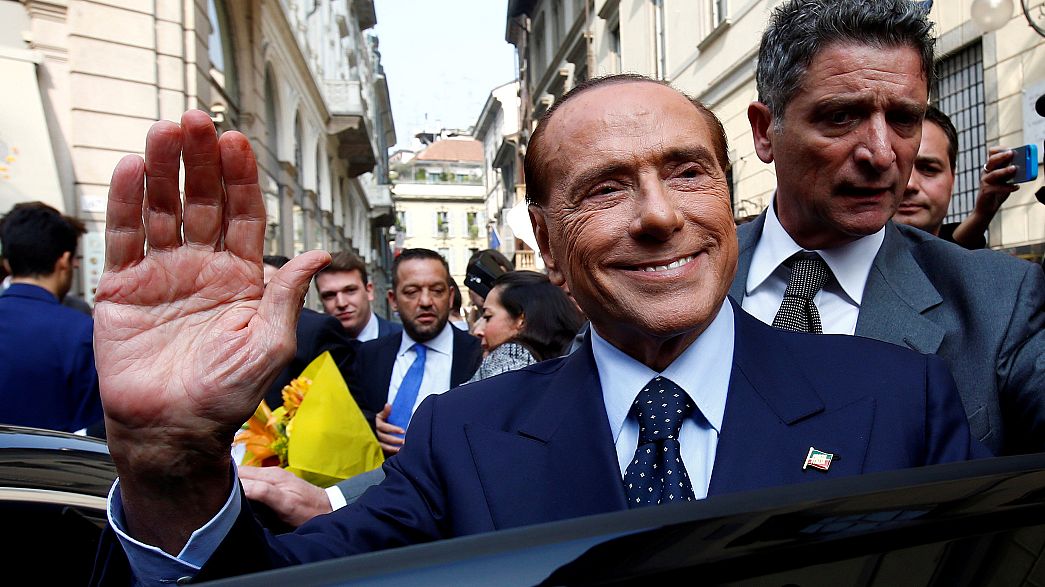
Meanwhile the elements the old right-wing triumvirate — Berlusconi the liberal-conservative, Bossi the northern secessionist, Fini the neofascist — are back. The heavy-eyed, knuckle-dragging Salvini has replaced Bossi. Giorgia Meloni has replaced Fini. Berlusconi has somehow replaced Berlusconi.
And there are new options. M5S will have an unprecedented role in parliament. Nobody quite knows what that will mean. Their program looks attractive enough from afar: a green government, guaranteed income for all citizens (an idea whose time has maybe come), greater attention toward the crumbling economies of the South. But M5S has never yet bridged the gap between its soaring rhetoric and its plodding governance. Virginia Raggi, M5S mayor of Rome, looked promising: young, female, energetic. Her mayorship has been a trainwreck. Likewise the mayor of Turin.
And whether or not M5S is technically fit to run a country, they may not be morally fit.
Renzi addressed the PD faithful last night on the last push of a tired and jaded campaign. “They want us to be ashamed,” he said, “but there is only one thing that embarrasses us, and that’s you all and your language, my Five Star friends… M5S’s violent way of doing things isn’t bad for PD. It’s bad for Italy.”
And correctly, courageously, he continued: “Italy does not belong to fascist murderers.” He was referring to the attack on Nigerians in the town of Macerata by a right wing militant and Lega Nord candidate, an act of violence whose brutality and banality captured the mood in Italy with sad precision.
Renzi seems confident of one thing: that he will remain the kingmaker of Montecitorio, the parliamentary palace, however many seats the rebel Five Stars take. Throwing down the gauntlet in his final speech, Renzi told Di Maio that PD would rather join the opposition than rule with M5S; he could only make that statement if he were certain that no one else would, either, and that sooner or later PD will end up in government, in a grand and unwieldy coalition with Berlusconi. But take note: Renzi’s confidence is never to be trusted. M5S may well form a coalition with the racist, Eurosceptic right.
This is the worst possible scenario: a M5S-Lega-Fratelli d’Italia (FI) government. It would be the first fascist government in Italy since the fall of the Social Republic. It would be the finishing flourish of a nightmare thirty years in the making. The rebirth of Italy, the energy and the force of spirit, the generations of genius and daring that made the world a place fit to live in, will be postponed another fifty years or more; and Europe will have to stagger on with a dead limb, with dead flesh in its Italian boot, contracting backward toward the Rhine, toward the old bickering of France and Germany, toward the grim, practical, industrial vision of European unity that preceded the Treaty of Rome.
M5S is a party that thrives on moods and hysterias, on resentment and the comfort of a crowd. It’s leadership is quick to accuse the media of being fake news — an apt little nod to certain spiritual brethren across the Atlantic — while peddling the grossest and most preposterous fake news on social media, including crudely doctored photos and bizarre insinuations. M5S is a party of frustration, certainly; of desperation, especially in the South. But it is also the party of ignorance, of small minds and withered hearts.
M5S is also a party with no moral grounding. It is proudly anti-ideological, and has changed drastically over the years. Its tone has changed: its views toward Vladimir Putin have notably changed form wry hostility to gushing support; it feels older than it did four or five years ago, grayer and stupider, and the votes it commands give the impression of an old man’s belly, massive but unhealthy. Its mutability is worrisome, because it recalls a small protest party 99 years ago that was vaguely progressive and revolutionary and run by charismatic speakers with great PR.
The Windrose is certainly not the first to make the comparison:
It will not be a government for Italian youth, who are pouring out of the country in the greatest migration in a century. It will be a government that inflames tensions between North and South, rather than easing them, a government that will let Veneto and Lombardy hold money that could be spent repairing roads in Basilicata, funding researchers at Università degli Studi in Naples, or microfinancing farms in Sicily. It will look to cut off capital flow from the rest of the EU, in a fatal gesture of “sovereignty.” And for all its law and order talk, a right wing government will continue to enable the Mafia, first by widening the job and power vacuum in the rural South, and second by its macho posturing, which goes a long way toward legitimizing the rule by gun.
But none of that is guaranteed to happen.
The best case scenario is a grand coalition of the center-left and center-right. Berlusconi’s ghost would haunt Rome once again, but it already has for some time now, and it shouldn’t surprise us. At least in his stead Berlusconi would send Antonio Tajani to Rome. Tajani is the President of the European Parliament, a staunch Europeanist — and a with a monarchist upbringing, which may or may not be a good thing. Italian monarchism always had two faces. Part of the movement, the part typified by Achille Lauro, was rebellious and populist, hostile to the cosmopolitan “elites” (!) and on good terms with the Movimento sociale italiano, the grandfather of all neofascists. The other part (the likes of Giovannino Guareschi) prized stability, dignity and tradition above all else. It took its Christian morality and its European legacy quite seriously. If Tajani comes to power and channels this legacy, he may prove to the moral glue that Italy desperately needs. And with Renzi, he could start the hard work of forming a serious government.
Italy’s Five Star Movement (M5S), the protest party that swept to power across the country in 2014, has never been a particularly well-oiled machine. Today ends M5S’ online primary ahead of the 4 March national elections, and in the comments section one user wrote,
“It’s like a scifi horror (è roba da fanta-horror).”
“Worthy of a Black Mirror episode,” said another, on Twitter.
It was the common consensus. And while it doesn’t bode well for Beppe Grillo’s protest party – anti-establishment, vaguely Eurosceptic, occasionally environmentalist, dedicated to direct democracy and revolt against what they call the casta politica — it’s not particularly atypical, neither of the party nor of Italy, a country adrift.
M5S has always been at home online, where it began as a kind of discussion meet-up series organized by the comedian Beppe Grillo. Its core activists are young and tech-savvy. A digital primary, where people could vote from home for which prospective parliamentarians they wanted to see on the party list, made sense. But when the Corriere della Sera looked into the problems with Rousseau, M5S’ online voting program, they found a system that simply, agonizingly – prophetically — did not work. It was slow; it crashed repeatedly; it didn’t register clicks. And as the deadline drew near, with votes not registered, it became a nightmare. Roba da fanta-horror.
Many began to suspect foul play: that Rousseau’s crash wasn’t a case of incompetency at all, or at least not entirely. Many prospective candidates found themselves shut out, and rumors over social media have all pointed at a rigged system, a fake election. There’s been no definitive confirmation of these rumors as of this writing, but the irregularities abound. Activist Sonia Corrado had the rare pleasure of finding out, on Rousseau, that she was running for Senate. Several incumbents found themselves missing from the lists. And now a video has gone viral, purporting to be a secret recording of one M5S activist speaking to another.
“It’s a madhouse,” says one voice. “The system doesn’t work.” The voice, marked by a heavy Messina accent, is believed to be a M5S parliamentarian.
“I’m getting tired of all these problems created by the staff.”
There’s something strangely apropos about the M5S mess, especially as the March elections draw near. These elections will be the first under the new Rosatellum scheme, a continuation of the (mostly abortive) electoral reforms by which the ex-premier Matteo Renzi, of the center-left Democratic Party (PD), tried to fix the systemic problems of Silvio Berlusconi’s electoral reforms. These latter were called Porcellum – the swine reforms, in the sense of greed and shit.
Rosatellum, in the grand tradition of simple, high-functioning, easy to understand Italian politics, gives 36 percent of seats in both houses of Parliament to winners of a first-past-the-post election, and 64 percent to winners of a one-round proportional vote. (Other seats go to unelected Life Senators and parliamentarians elected by Italians abroad.) It’s a system that will reward coalitions; this had infuriated M5S, which has long taken pride in being a party that isn’t a party, a body of citizens organized along principles of direct democracy and in opposition to coalitions and compromises.
The Rousseau scandal may go a long way toward eroding that ideal.
PD, who have been hemorrhaging votes in the South since Renzi’s chinless posturing and pointless referendum in 2016, stand to lose too – if not to M5S than to a center-right coalition led by the odious Lega Nord and the ghost of Berlusconi, who is barred from holding office but currently appealing that ban in the European Human Rights Court in Strasbourg.
(He’s back!)
The election, in short, will be brain-achingly complicated. It’s not likely to do much, either: Italian public debt amounts to about 2.3 trillion Euro, second only to Greece in the Eurozone. Meanwhile Italy’s recession drags on and on; and as important a role as Italy plays on the European stage, from taking the lead on Mediterranean security to fielding high-ranking Eurocrats like Mogherini and Tajani, Italy has never looked more adrift, without direction and with precious little hope. It’s partly Renzi’s fault. It’s much more Berlusconi’s fault, incalculably more, for his erosion of civic discourse and his cultivation of public corruption unseen since the scandals of Bettino Craxi. And perhaps it’s simply in Italy’s stars to never quite function right, at least not yet or not now or not anymore.
M5S’ implosion is a sign of the times. Grillo’s party has a number of kindred spirits across Europe – notably in the Czech Republic, where the ANO (Yes!) Party has also stormed Parliament demanding an end to rule by the “elites.” ANO shares M5S’ technology fetish, its Euroscepticism and its friendly stance toward Russia. Anrej Babiš, ANO’s founder and now-ex-Prime Minister, shares Grillo’s charisma, salty language, and dictatorial instincts. His businesses are tied up inextricably with his party, like M5S with the Casaleggio Associates, a tech company founded by the late Gianroberto Casaleggio that has profited enormously from M5S’ rise to power.
Babiš just resigned after a no-confidence vote in the Czech Parliament – just ahead of a presidential election. In this season of bad faith, black omens and Black Mirrors, the ripples of fate may well be moving south.
The Windrose‘s 2017 hiatus is over. It’s good to be back.
The Catalonian crisis of 2017 isn’t close to being over. The regional elections just before Christmas gave an absolute majority, 68 seats in a Parliament of 135, to a separatist parties. The outlaw Carles Puigdemont’s liberal nationalists, JuntsxCat, received 34 of those. The Republican Left took an incredible 32. Els Ciutadans, the liberal anti-nationalists (or post-nationalists, or however you want to describe them) remains the greatest single party, with 37 seats, but if the separatists can form a working coalition across the left-right spectrum we may see a second push for independence in 2018. A serious one.
The last attempt felt distinctly amateurish. The secret urns, the pathetic turnout, the Guardia Civil beating old women in the street, Puigdemont playing Bonnie Prince Charlie. And it felt amateurish most of all because of the inconsistency of the message, on both sides of the fight. The independence movement claimed to be the Europeanists; they were asking to leave the European Union, in defiance of the Maastricht Treaty no less, which establishes the EU as a body of sovereign governments and not of nations. Spain signed; Catalonia did not. And it’s a strange kind of Europeanism that Nigel Farage and Sputnik News can get behind.
More troubling than Farage and the Kremlin’s support, though, was Matteo Salvini’s. Salvini, the bearded, bumbling right-wing chief of Italy’s Lega Nord, is currently trying to resole the old boot of Berlusconi power, and is fishing for votes in the Center and South. But he comes from a tradition of Northern separatism quite similar to Puigdemont’s. Its strongholds in Lombardy, Veneto, the Piedmont, and increasingly in Emilia-Romagna are wealthy industrial zones, resentful of the rural South, which the Lega sees as parasitic. Many Catalans hold similar views: they, the industrious North, have handed their wallets to the lazy, corrupt Andalusians and Extramadurans. Under these old resentments are even older prejudices, namely the one that holds that race is a continuum of North and South: that southward the people get darker, lazier, more venal and more corrupt, while northward they get larger, paler, more industrious and more honest. Greeks and Persians, Romans and Egyptians, Protestants and Papists, the Nordic race and the Mediterranean. It was false in Aeschylus’ day, and it’s false now.
But whatever old prejudices are hiding in Salvini’s tweets and Puigdemont’s speeches, there are worse problems for Europe. The EU survives by recycling economic surpluses — or at least it should. The dream of a unified Europe, as old as Goethe and Victor Hugo and Garibaldi and Churchill, is not enough to keep a monetary union bound together. Exporting economies need to be willing to hold up the rural and underdeveloped ones, not just in the form of investment across the Union, but in the form of fiscal transfers. The proper mechanism for such transfers is sadly lacking in the EU, and is worth a thorough examination. But you’ll remember the rancor of the 2015 Greek crisis — the bitterness of the Germans at having to pay off Greek laziness. Greek “laziness,” rather.
This all seems out in the weeds. But it highlights the greatest irony of the Catalonian situation: that the Catalonian independence movement runs on the same logic as the Bundesbank and the German conservatives, who wanted to wash their hands of a European nation, a fellow EU member, rather than bolster them.
If Catalonia isn’t willing to support Andalusia, why should Milanese taxes support Naples? Why should the Bundesbank be responsible for unemployed Greeks?
(They should care because Southern emigrants literally made the Fiat cars of Turin and died in the armies of the House of Savoy and dug the coal in Belgium that made the EU possible. And because the Bundesbank’s predatory lenders in the 1990s knew exactly what they were risking when the Euro was established and Greeks could take out German loans. And because Europe is an end in itself.)
I say all this with a little sadness, though, because part of me likes the Catalonian independence movement. Like most of Europe, I was disgusted by the Guardia Civil’s violence. Moreover I like the romance, frankly, and it’s a little hypocritical of outlets like the Windrose to support the Scottish National Party, say, and not the Catalonians. (SNP’s 2014 referendum was legal and not bungled, so at least there’s that.) The Windrose also enthusiastically supports the cultural diversity of Europe, which means embracing the ancient local cultures of places like Catalonia. There is nothing remotely contradictory about Catalonia a nation — a Catalonia that speaks Catalan in its schools and courts, maintains its own gendarmerie, watches Catalan news instead of Spanish networks, seeks protected status for Catalan food, teaches Erasmus students in Catalan, and lists its nationality on tax forms as Catalan — and a Kingdom of Spain that includes Catalonia, with fiscal transfers from wealthy regions to poorer regions.
Madrid might do well to consider a few more degrees of Catalonian autonomy in exchange for that. Even symbolically: suppose the name of the country changed? “The Kingdom of Spain and Catalonia.” “The Kingdom of Spain and the Catalonian Lands.” There is no shortage of historical precedent: the United Kingdom of Great Britain and Northern Ireland, surely, but also Bosnia and Herzegovina, and the Kingdom of France and Navarre, The Kingdom of the Southern Slavs, the Empire of All the Russias.
“Negotiating,” Puigdemont recently wrote in Politico, “is not a sign of weakness or cowardice.” We’re only 12 days into the year. We’ll see if anyone agrees with him on that.
“But we, who are neither Jesuits, nor democrats, nor even sufficiently Germans, we good Europeans, and free, very free spirits–we have it still, all the distress of spirit and all the tension of its bow!”
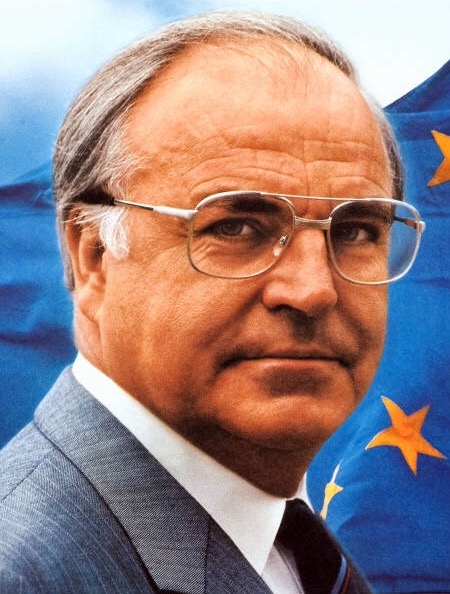
Helmut Kohl was laid to rest this week. At Speyer Cathedral, where his funeral mass was held, they draped his coffin with the German flag. But earlier at the European Parliament building in Strasbourg, where a strikingly young orchestra played the Ode to Joy, they covered him with the blue flag of the EU. You wonder what Nietzsche, prophet of the Good European, would have made of this man, this blundering statue of a German, so big and so small, like Nietzsche himself; so German and so un-German. He was a figure, it seemed, out of Stendhal. This center-right defier of the Bundesbank, Reagan and good liberal logic; this Catholic Rhinelander elected in the home of the Reformation; as Olympian as De Gaulle and as folksy as George W. Bush; canny and ingenuous, unifying Germany and taking his political funds in small notes tucked into unmarked envelopes; this pilot of a “kindhearted Europe,” in Emmanuel Macron’s words, a political animal who nursed Angela Merkel, the Valkyrie of austerity.
Wolfgang Schäuble is another of Kohl’s gifts to Europe– a man whose name by now is a byword for quiet war in Europe, for German posturing and chest-puffing in front of Paris, of Greece ground into nothing by piratical debts, of all the aggression and coercion of 1939 and 1914 and 1871 and 1618 papered over with the thin pages of the Treaty of Maastricht: the bit about division of the European continent, and solidarity, and ever closer union.
Enough has been said by now about Helmut Kohl, about German unification and about his abiding faith in European unification. But there are two points in his career that I would like to recall.
Well, three points. The first is that the man loved to eat, especially country cooking, and even published a cookbook with his wife Hannelore. His favorite dish to ease visiting heads of state into an amenable mood was, infamously, Saumaugen, a dish minced pork and potatoes sewn up in a pork stomach and boiled. This alone qualifies him as the greatest European statesman in recent memory.
Moving on, though, Merkel seems every bit the canny conservative that her mentor was. Look at her gay marriage maneuver last week. Merkel called a snap vote on gay marriage, made a show of opposing it, and watched it pass in the Bundestag. It worked. She satisfied both conservatives of her good will and leftists of her wise administration, just ahead of the general election. Kohl’s abortion program — keeping it illegal in former West Germany but legal in the former East, with a reconsideration sometime in the future — was just such a move. A Christian Democrat and one of Europe’s prominent Catholic statesmen, Kohl couldn’t liberalize abortion without major backlash from his voters. But Kohl’s heart lay closer to the center than many of his voters’. (In 1990, Vanity Fair noted that for a conservative Catholic so famous for his appetites, Kohl had only two children in his many decades of marriage, spaced neatly apart by two years: hard to pull off without certain kinds of help.) The gamble almost sank unification. But, like Merkel’s, it worked.
But the most striking thing about Helmut Kohl is what none of the obituaries are talking about: that he defied the Bunesbank and threatened the strength of the Deutschmark, for the sake of a unified Germany.
West Germany was an industrial superpower, East Germany was a languishing post-communist state. The Bundesbank was terrified that East Germans would weaken the Deutschmark; in the end, ironically, it was the Deutschmark that kept East Germany weak, as newly liberalized factories scrambled and then failed to keep up with the demands of the new currency and the abundance of cheap imports from countries like Japan. It was not a well-thought-out process by any means. The fact that Kohl pulled it off, again, on the eve of an election (politicians like Kohl spend their entire lives on the eve of an election) doesn’t make the episode look any less like a failure.
But for all that it was bungled, and for all the cynical politics attached, the monetary union was also an act of patriotism. It was an act of courage and faith, a leap into a new Germany. And between the advice of the banks, and the needs of his country, Kohl chose the latter. Twenty five years later the Bundesbank would make a similar pronouncement about Greece — that bringing Greece in from the cold was suicidal, at least without massive austerity. The year 2015 needed a good European, in Nietzsche’s terms, in Berlin — not a narrow German. The beefy Rhinelander with a country accent would have fit the bill better than any of his successors.
Welsh Labour is surging. A Cardiff University poll put them at 44% (+9) in its last sounding, and expects the Conservatives to lose a seat.
This is extraordinary, because the same Welshmen backing up Labour voted almost unanimously for Brexit, against the wishes, programs, and pleading of their party. Now they will vote for a Labour Party that is, in some ways, more radical than Corbyn’s national Labour Party. First Minister Carwyn Jones has been demanding that Wales remain in the Single Market for almost exactly a year now, a position that Corbyn refuses to endorse or even properly address. Jones’ Brexit White Paper was co-written with his left-wing former opponents in Plaid Cyrmu, and this week Jones took up another of Plaid’s longstanding demands, the abolition of the Barnett formula. (The Barnett formula allotts money to Britain’s devolved governments.)
Plaid isn’t happy about this bit of poaching by Labour. They reminded the BBC that Corbyn had specifically supported the Barnett formula. Well, maybe that’s just the point.
It’s a strange time for Mr. Jones, undoubtedly, the Europhile first minister of the Brexitest tribe in Britain, now tacking left in SNP and Plaid’s direction, now tacking right in the general criticism of Corbyn, refusing to mention him in his May election statement and claiming that “only Welsh Labour will stand up for Wales.”
(Carwyn Jones, AM for Brigend. As friendly as he looks but shockingly tall. From Wikicommons.)
And, when the EU funds and CAP payments finally dry up, he’ll be the First Minister over a nation with no jobs, no mines, over half of its farmers making net negative income, and no constitutional means of staying in the Single Market.
If Jones wins on the 8th — and it looks like he will — it will be his grim coronation as the Fisher King of Wales.
It’s not for lack of effort, to Jones’ credit. One 1 March of this year, Saint David’s Day, I met the First Minister at a reception hosted by the Congressional Friends of Wales Caucus on Capitol Hill. He smiled and he joked and his staff showed videos of sleek new infrastructure in Wales, but the mood was grim.
“The first thing I want to emphasize,” he told the room, “is that Wales is open for business.”
But you saw a different story in his eyes, when he looked down at his Diet Coke and away from the Congressman pumping his hand. When I asked him there was any cause at all to be optimistic following Donald Trump’s election — military spending was due to rise, and American defense contractors like GE Aircraft and General Dynamics are major outside employers of skilled Welsh workers — he shook his head sadly and said,
“No.”
Just no, full stop. There was no cause for optimism. Pressed on it, he said that Trump had run on a promise protectionist economics. The “special relationship” between Trump, whose trade policies sound like Steve Bannon’s attempt at Mussolinian autarky, and May, the Queen of Hard Brexit, would never revive Wales.
(The special relationship. A thousand words, et cetera.)
Open for business: the First Minister had come looking for trade partners with the full knowledge that he had nothing the United States wanted, including, frankly, another foreign exporter. One product Jones was pushing on his March trip was Welsh lamb, the major agricultural product of Wales — 93% of which, according to journalist and farmer John Wilkes, has been exported to the EU up until now.
It would be a hard sell. For one thing, the US Department of Agriculture Animal and Plant Health Inspection Service (USDA / APHIS) still enforces its 1990s ban on British meat products, a ban intended to keep mad cow disease out of the United States. The ban is outdated, and USDA has held some tentative talks with the British government on ending it. But it’s still on the books, and however anti-regulation Trump might be, British lamb is hardly one of his priorities. Or, for that matter, Theresa May’s.
But worse luck for the Welsh, Americans have little stomach for lamb and none at all for mutton. (Which is a desperate shame, because if mutton were available in Washington at least one journalist would buy it by the metric tonne and live on nothing else.) The lamb that Americans do eat comes vastly from Australia and New Zealand, which pays little in tariffs. And the supply is frighteningly big — only 9.3% of Australian lamb exports, for example, go to the US, and that 9.3% comes out to 13,753.68 metric tons of meat. So if Americans did start eating more lamb, it would come from the Pacific. Not from Wales.
Mr. Wilkes, at least, was not pessimistic. Millenials are eating more lamb than their parents, thanks to their cosmopolitan taste, and UK lamb might prove attractive to upscale, organic-meat consumers.
We wish them godspeed. But if there’s a miracle recovery in Wales, Labour government or none, it won’t be due to more kebabs in New York. Only reentry into the Single Market can breathe life into Wales. And if Corbyn won’t say as much, Jones at least will.
It’s strange to think now that a year ago, or just under a year ago, when Theresa May moved into Number 10 Downing Street, she looked invincible.
And that when she called a snap election, it looked like a brilliant coup. Brexit had triumphed. Labour was in a shambles, hemorrhaging votes in its industrial heartlands and captained by a man who looked more like a bitter ex-husband (“her” government, Corbyn would say in Prime Minister’s Questions, she said, never mentioning May by name, while May coolly and scrupulously called him the Right Honourable Gentleman) than a prime minister.
Now the Tory manifesto is foundering, inconsistent, today on income tax, just yesterday on public housing, earlier on insurance of the self-employed. (The older inconsistencies in the Conservative Party are also lurking just under the surface, and came up again during the 31 May BBC debate, when Caroline Lucas of the Greens reminded Amber Rudd of her past as a Remainer. But more on that later.)
Corbyn, against all odds, is looking splendid. Remember the referendum campaign, when old Labour voters were voting Out just to spite the spindly, finger-wagging Islingtonian? Theresa May, who looked capable and confident every Wednesday for months, is now in hiding. She literally hid on the 31st, of course, by not showing up the debate. But look at her interview with the Plymouth Herald, the newspaper of a strongly Conservative town in the Conservative, Brexiteer stronghold of Devon.
This was no master class on the subtle art of evading questions. It was a point-blank refusal to say anything. Sam Blackledge of the Herald asked four questions, and look what responses he got:
On visiting a marginal constituency like Plymouth only twice in six weeks: “I’m very clear this is a crucial election for this country.”
On whether the Prime Minister will protect Plymouth from more cuts to their vital military infrastructure: “I’m very clear that Plymouth has a very proud connection with the armed forces.”
Bloody hell, Theresa.
She didn’t answer anything, because she really has nothing to say. For months now the Prime Minister has relied on a few rhetorical formulae — STRONG AND STABLE, STRONG AND STABLE, over and over — because STRONG AND STABLE is stronger, and more stable, than anything the Tories can offer.
The Prime Minister’s colleagues are doing the same thing. See Amber Rudd’s “money tree” line in the debate, which constituted about half of all the words she uttered that night. Maybe she figured that the old “money tree” line would be enough, that it would resonate with elderly voters in Kent who had themselves droned on and on about money trees in their own living rooms. It would be a tactic rather similar to Paul Nuttall’s insistent accent, which is admittedly more convincing than any of the monosyllables he typically manages. But given Rudd’s face throughout the evening, I’d say she’s not particularly convinced herself.
Other takeaways from the debate, besides the May Queen’s absence, Rudd’s visible discomfort, and Nuttall’s juvenile blathering? Corbyn looked… all right. He was more comfortable than we’ve seen him in a while, perhaps because between the left-leaning audience (note the applause) and a field that skewed left, with Labour, the Greens, SNP, Plaid Cymru outnumbering the Tories, Lib Dems, and UKIP, he could speak as a leftist and not in an unconvincing pretense of centrism. Was that an “exploitation of the workers” I heard at one point? The honesty of it was actually refreshing.
Tim Farron’s performance was brilliant, and even his anecdote about his mother’s illness came across as something emotionally genuine — so many politicians make stories like that sound cheap and tawdry and exploitative. Although his snide comment about “hair shirt Muesli eating Guardian readers” was revealing about who Farron is and what a strong Lib Dem voice in government would look like. His Brexit policy has always felt strongly anti-democratic. A second referendum seems dubious, like a coworker that asks you out every day in the hope that eventually that stars will align right and you’ll say yes; and, like liberals from John Stuart Mill to Wolfgang Schäuble, Farron seems to prefer a strong technocracy to a messy democracy.
Nevertheless, I wish Corbyn had been as adamant about staying in the Single Market as Farron and Robertson had been.
Angus Robertson was tough and intelligent, as he always is. His clash with Corbyn over immigration was fascinating — Corbyn pulling on his coveralls and no-slip boots to demand better control of immigration, and Robertson condemning him for borrowing a line from UKIP. It was a bit of dishonesty on Corbyn’s part, though, because now that the UK is leaving the EU, it will be that much harder for British businesses to hire in or from countries were wages are low, like Poland, and because fewer immigrants does not correlate with higher wages.
The real solution, of course, is a consistent floor under wages across the EU and a recycling of industrial surpluses back into places like Poland and Romania to support it. But that would require a number of impossible conditions, like a political union on the Continent and a changing of the guard in the Bundestag. Oh, and for Britain to be in the EU. That would be important, too. Corbyn, in the meantime, can be forgiven for his olive branch to the voters in the Midlands and Wales, however ill-plucked.
Wood and Lucas performed marvelously, considering how unlikely they are. Wood seemed not to have considered matters of security at all, and looked confused by the question. And Lucas gave us the quote of the night. Nuttall, in the Reddit-mysognist tradition that comes naturally to UKIP, declared that he wanted to make no “divorce payments” to the EU. Lucas asked him if he’d do the same thing in real divorce.
“We all know blokes like you,” she said. Indeed we do, Madam, indeed we do.
So here’s the part you were waiting for. The Windrose endorses the Labour Party for the 8 June 2017 general election — except for the constituencies within Scotland, for which the Windrose endorses the Scottish National Party. (Up Scotland! Free and European.) And let Rudd and the May Queen be strong and stable on the far benches, where no one will ask them any questions.
First, you’ll notice that this post was written in New Orleans. (Be jealous!) I’ve been attending an advisory committee of the Department of Veterans Affairs (VA), held at the new VA Hospital on Canal Street.
(House in the Faubourg Marigny, from Wikicommons. See below for more.)
What we covered isn’t necessarily of interest to Windrose readers, but it’s worth pointing out that the VA is working hard to clear up the mess of its 2014 scandals, and while certain regional offices of the VA are doing well — San Diego, for instance, and now New Orleans post-Hurricane Katrina — others are decidedly not. The United States is a country where respect for veterans has solidified into a cult, a cultus in the Roman sense, equal parts a civic and religious devotion. Everyone from Congressmen to stadium announcers to radio DJs invoke the veterans and, especially, the gratitude Americans owe them. It’s not a bad thing, even if it is a bit puzzling to people from other countries. (It can sound a bit Greek colonel-y to European ears.) But it makes some of the points discussed in this week’s committee meeting even more uncomfortable. Twenty American veterans take their own life every day, for instance. Only about six of them will have been previously identified as at-risk by the VA. The past three Secretaries of the VA have made zero veteran suicides a goal for the Department, but for all the new facilities and telehealth capacity in the works, that figure doesn’t seem to be going down.
No one should be sent to war and then abandoned as soon as they’re home again. The VA senior staff would be the first to agree with that. So would just about every American, and sincerely. And yet the contradiction between the constant invocation of “our veterans,” and the reports we heard this week about veteran health and suicide, is sharp, and ugly.
UK ELECTION
The Independent ran a story this week on a UKIP candidate in Norfolk, who made some, er, interesting claims about her party and race.
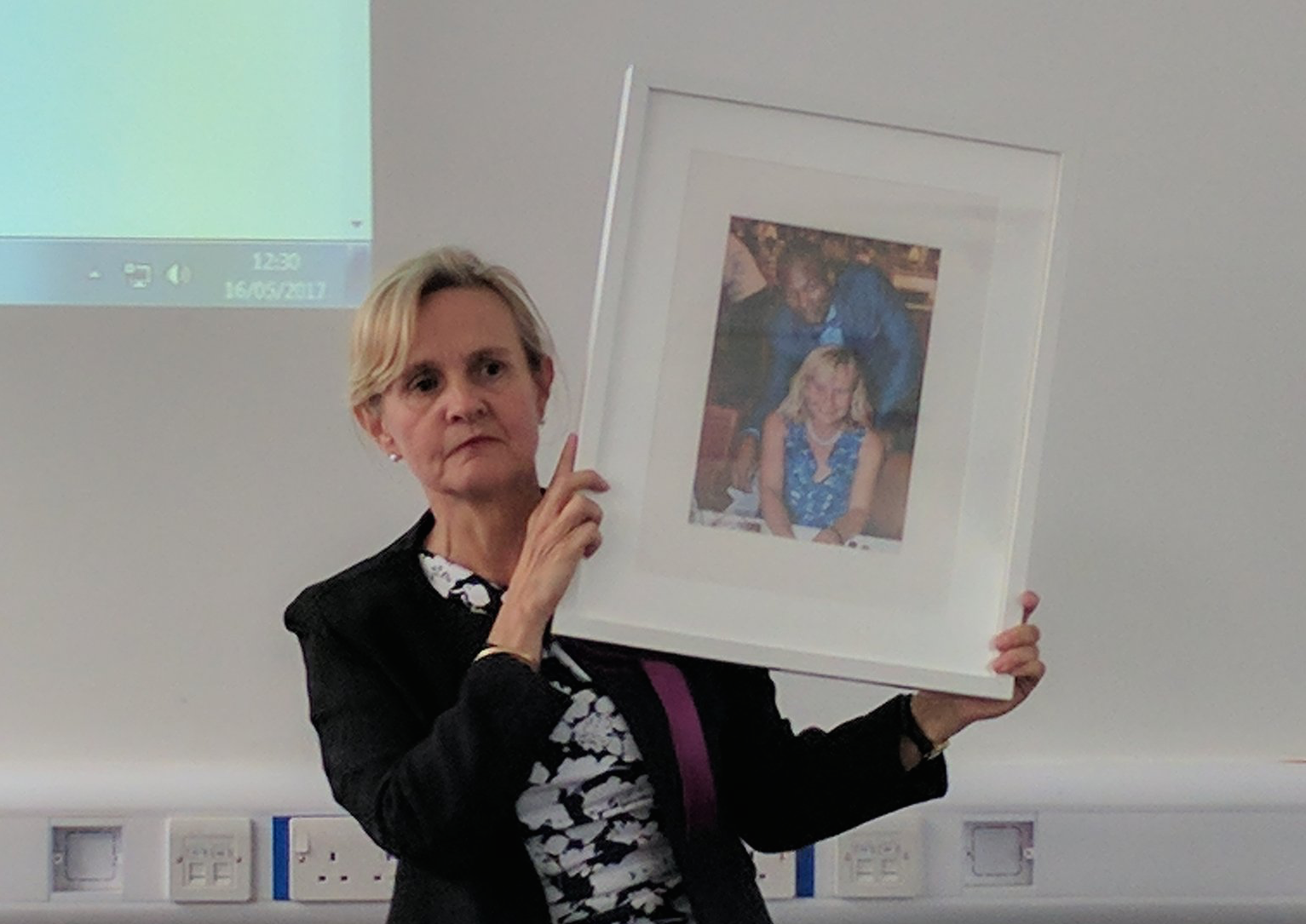
Catherine Blaiklock , running in Great Yarmouth, decided to prove once and for all that her party was not racist. She actually brought a photo of her black British-Jamaican husband to a debate and held it up:
Ms. Blaiklock later told Vice, “I sleep with someone who is black, who is, you know, of Jamaican origin! So I am 100 percent not racist.”
Cue the Get Out trailer:
Ms. Blaiklock was also proud to point out the UKIP is the only party in England that screens its candidates, to keep out supporters of the racist British National Party (BNP). Of course UKIP does. UKIP is the only party that needs to. And even then, BNP will lay always behind UKIP like a nasty shadow. Like Jobbik lays behind Fidesz, in Hungary, and like American racist Richard Spencer’s National Policy Institute behind Steve Bannon and the Breitbart News crowd.
Ms. Blaiklock, for the record, want to “Make Yarmouth Great Again.”
IN WASHINGTON, THE RATS JUMP OFF THE SHIP
The big stories out of Washington right now are about the chaos — the rumors, Trump’s pressure on Comey, the secrets exchanged in the Oval Office, the spies of the Kremlin. What’s just as interesting, though, are the predictable parts of the story.
Like Trump backing down from his bold promise to break up the banks. For all that talk on the campaign trail about the nefarious power of Goldman Sachs behind Hillary Clinton, Trump never had any personal animus toward financialized capitalism. He’s no Red Tory and he’s no more a working class champion than his friends across the water, Mr. Farage and Madame Le Pen. He’s a New York business mogul. Full stop.
Another prediction coming true: now that Trump’s ship is sinking, all the rats are jumping off. Ann Coulter, according to Fox Insider, is “ready to jump ship.” There you go. Now Jason Chaffetz is quitting. Probably just in time. He won’t be the last Republican to run for shelter, and the sight of Ryan and McConnell on national television insisting that they had always opposed the President will, sadly, not surprise anyone.
I don’t like Jason Chaffetz. But I am grateful to him: he proved that an alliance between the green left and rural voters is possible, not just in the Global South or European countries like France but in the United States.
Chaffetz was all intent on selling off Federal land, but a coalition of rural hunters, fishermen, outdoor enthusiasts, together with urban environmentalists and conservationists, forced him to call it off. The Windrose stands firmly in favor of continuing that alliance into the future: not just on issues of public land and national parks, but of water and air quality, further subsidies for small to medium scale agriculture, the encouragement of responsible hunting, rewilding and the protection of endangered species, and increased investment in rural communities, to include universal access to WiFi.
EN MARCHE!
The Windrose notes with approval French President Macron’s broad, cross-party picks for his Cabinet. We especially welcome the fact that half the Cabinet are women, and that the Environment Minister is Nicolas Hulot, the former Green Party candidate and TV host.
Hulot’s background as a nuclear lobbyist is troubling, but not too troubling, and it’s as much of a relief to see a Green on Marcon’s Cabinet as it to see so few former Hollande stalwarts. Marine Le Pen, after all, had insisted that a Macron presidency would be Hollande Part Two.
Defense Minister Le Drian is also reassuring, despite the neocolonial, paternalistic overtones of his work in Mali. A Socialist Hollande holdover, he is staunchly pro-NATO at a time when the Atlantic Treaty is retreating east, back to Europe. His expertise will be critical in maintaining European security.
The Cabinet as a whole has a Gaullist feel to it this time around, much more than it did under Hollande. And that is decidedly a good thing.
NEW ORLEANS
As promised.
The Faubourg Marigny is still beautiful and crazy, the Spotted Cat is still packed to the windows and everything still smells like beer and pee and mildew and honeysuckles. It’s a bit like the neighborhoods in my home town that I miss, only crazier. But there’s something troubling afoot: almost everyone there was young and white.
An artist I met on Frenchman Street, also young and white, directed me to St. Cloud for a drink. I went. I loved it. It was the kind of place I like: brick walls unpainted, dogs sleeping on sidewalks, people relaxed and happy to shoot the breeze. But it was just as young and white: maybe 70 percent white to 30 percent black is my guess. New Orleans is 60 percent black, according to the 2010 census. I’m young and white, and this bothers the hell out of me.
The Windrose is based out of Washington, DC, and everyone in DC is familiar with the G-word: gentrification. It’s a nightmare. In less than five years there will be a Whole Foods in Marigny, and everything will be over. At that time the people of New Orleans — the real people, the ordinary people, the decent people — must take back control. It used to be manageable; it’s not anymore. They must put a stop to this out of control immigration. There must be much stricter border controls — maybe a wall — and better vetting, to make sure that the people coming into New Orleans don’t bring their foreign, un-New Orleanian values with them, that they respect the local culture. New Orleans for the New Orleanians.
Now that our blog is more or less up and running, you can expect weekly or biweekly updates. Well, hopefully, anyway. Upcoming articles include stories on Northern Ireland and the Catholic Church, the recent self-defense legislation in Italy, the leaked Labour Party manifesto, the cyclical history of one Stephen Bannon, and a review of Yianis Varoufakis’ new book. So keep reading, and don’t forget to subscribe!
Meanwhile, here’s what we’ve been reading this week:
“Diary” by Fida Jiryis in the London Review of Books. A moving first-hand account of Palestinian life in Israel, outside the West Bank. She’s a brilliant writer, and we can’t wait for her book, Kingdom of Olives and Ash, to finally come out. You can bet we’ll review it here.
…there’s actually only one, it’s been a busy week. Try again next time — and in the meantime, read Fida Jiryis’ story.
The French election is over and the French pollsters were, shockingly, exactly right.
One of the problems in coverage of the election was that Macron’s policy were juxtaposed with Le Pen racebaiting, and not with her actual manifesto. That’s partly a media problem, one which the press discovered for themselves the morning after the Brexit vote and then again after Donald Trump’s election. But it was also Le Pen’s fault — her debate with Macron made it clear that she hadn’t given much thought to the economy at all, besides a few too-good-to-be-true promises of lower taxes and more jobs for Frenchmen.
It has been easy to imagine a Macron-era France. What would France have looked like in the Age of Le Pen? A corporate free for all with a Praetorian Guard of obnoxious Nigel Farage types, insulting the critics on TV? A dreary, post-interesting, Hungarian-style Orbánocracy?
After the results came in and everyone could breathe again, I looked up Jane Kramer’s 1986 article for the New Yorker about the rise of Marine Le Pen’s father Jean-Marie, “The Mayor of Dreux” (found in Europeans, Farrar Straus & Giroud, 1988). What I wanted was a vision of what a Le Pen might look like in power. Marine, of course, was nineteen in 1986; the article is about her father’s party, which she would argue with good cause is not her own. And admittedly it feels sort of medieval and arcane, this kind of prognostication, like a monk consulting Virgil to predict the date and time of the Last Judgment.
But for all their troubled history, Marine Le Pen, in the words of the New Yorker’s Moira Weigel, “has become her father’s daughter. But then, she always was.” Grosso modo, anyway. Read her review and see what you think.
In any case, I thought Kramer’s Dreux article would shed some light on the bullet just dodged. And — it did. It really did.
It was all a little too familiar.
In response to newspaper allegations that Jean-Marie Le Pen had tortured Algerian prisoners: “Le Pen sued the two newspapers for defamation. He… told the judge, ‘I have never had the authority to conduct interrogations… If I had, I would certainly have conducted them.”
“Le Pen likes to sue the people who criticize him. The Seventeenth Correctional Court at the Palais de Justice in Paris has had a full docket of Le Pen’s lawsuits for so long now that reporters call it la chambre Le Pen.”
“[Le Pen-associated daily] Présent is known for monitoring Justice Ministry lists of people who change their names (Mohammed to Moland, Ben Ahmed to Reinhardt, Boulaloud to de Connick, Mahbouli to Michel)…. As for M. Badinter, a well-known [Jewish] law professor and civil-rights lawyer who has just finished revising the French criminal code, ‘he is the very symbol of a France open to foreigners. His father was a furrier.”
“He [Le Pen] is big, and he is overweight…. He flaunts his weight like a weapon. His shirts pop open…. His holiday snapshots have him windsurfing in a tight black rubber suit.”
“Le Pen is rich…. Montretout [Le Pen’s exclusive gated community in Saint-Cloud] today is a hilltop bunker where the world is barred and megalomania can flourish. Pierette Le Pen [Le Pen’s ex-wife] says that he husband promised her the Élysée as ‘a Paris pied-à-terre,‘ and in all likelihood he did.”
“Le Pen is shameless. He is successful because he is shameless. He knows that millions of Frenchmen are frustrated, and that their frustration has something to do with a conviction that history has betrayed them — and he exploits that conviction.”
So maybe we do know what a Le Pen presidency would have looked like. Again, grosso modo. But it’s all too familiar for comfort — especially on this side of the Atlantic. France might not have found its new De Gaulle, but it dodged a bullet, and that’s no small relief.
Congratulations, Monsieur le Président, and good luck.



 The Windrose